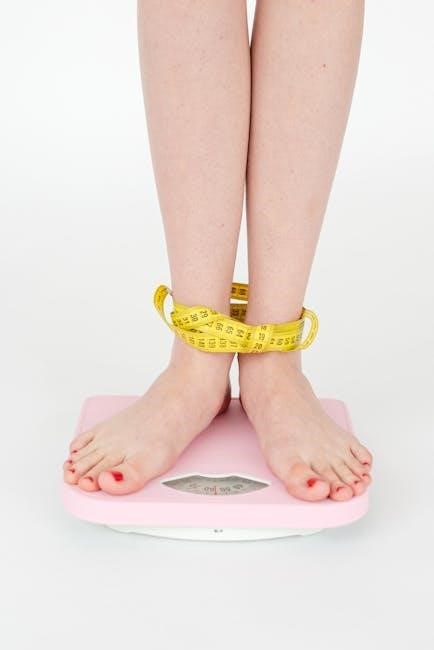
WW Scale Instructions: A Comprehensive Guide
Welcome! This guide provides detailed instructions for your WW scale, enabling personalized body analysis for up to four users. Familiarize yourself with the process before beginning, keeping this manual close by for step-by-step assistance.
Understanding Your WW Scale

Your WW scale is a sophisticated body analysis monitor designed to track key health metrics. It’s capable of storing personalized data for up to four distinct users, identified as P-01 through P-04. The scale utilizes intuitive button controls – SET, and Up/Down arrows – to navigate the setup and customization processes.
Before initial use, understanding the scale’s functionality is crucial. It measures weight and provides body analysis readings, but accurate results depend on proper setup. The scale defaults to displaying height in inches when set to pounds (lbs) and centimeters when set to kilograms (kg). Customization allows you to input your height, age, and gender for more precise calculations.
Remember to gently step onto the scale to activate it; the display will initially show “000” then transition to “0.0”. The SET button is central to confirming your selections during the user profile setup.
Unboxing and Initial Setup
Carefully remove your WW scale and all included materials from the packaging. Inspect the scale for any visible damage that may have occurred during shipping. Ensure you have the scale itself, this instruction manual, and potentially batteries (depending on the model – check packaging).
Before first use, locate the unit selection switch on the scale. This switch allows you to choose between pounds (lbs) and kilograms (kg) as your preferred unit of measurement. Select your desired unit before proceeding with user profile setup.
Place the scale on a hard, level surface. Avoid carpeting or uneven flooring, as this can affect accuracy. It’s recommended to position the scale in a convenient location for regular use. No complex assembly is required; the scale is ready for initial power-on and user customization immediately after unboxing and unit selection.
Powering On and Basic Operation

To power on your WW scale, simply step onto the platform with one foot. The display will briefly show “000” and then transition to “0.0”, indicating the scale is calibrated and ready for use. The scale automatically powers off after a period of inactivity to conserve battery life.
Basic operation involves stepping onto the scale to obtain a weight reading. Ensure your weight is evenly distributed across the platform for the most accurate measurement. Avoid sudden movements while the scale is measuring.
The scale utilizes simple button controls: SET, and Up/Down arrows. These buttons are crucial for navigating the user profile setup and customizing your body analysis monitor. Familiarize yourself with their location and function before proceeding to personalize your scale settings. Remember to gently step on the scale to initiate the process.
Unit Selection (lbs vs. kg)
Your WW scale offers the flexibility to display weight measurements in either pounds (lbs) or kilograms (kg). This selection is made via a physical switch located on the scale itself. Before beginning the user profile setup, ensure the switch is positioned to your preferred unit of measurement.
If the switch is set to ‘lbs’, the scale will default to displaying height in inches during the personalization process. Conversely, if the switch is set to ‘kg’, the scale will default to displaying height in centimeters.
This setting doesn’t affect the scale’s ability to accurately measure weight; it only alters the units displayed. Changing the unit requires physically adjusting the switch and may necessitate re-entering your user profile data for consistent measurements. Always double-check the switch position before each use.
User Profile Setup: A Step-by-Step Guide
Personalizing your WW scale for each user ensures accurate body analysis. Begin by gently stepping onto the scale with your foot; the display will initially show “000” then transition to “0.0”. This indicates the scale is ready for setup. Press the ‘SET’ button to initiate the user data configuration process.
The display will then flash “P-01”, representing the first user profile. Utilize the ‘Up’ or ‘Down’ arrow buttons to select your desired user number, ranging from P-01 to P-04. Once the correct user number is displayed, press ‘SET’ again to confirm your selection and proceed to the next step: height setting.
Follow the on-screen prompts and button instructions to accurately input your height, age, and gender. Remember to press ‘SET’ after each entry to save your data.
Selecting the User Number (P-01 to P-04)
After pressing the ‘SET’ button to begin user profile setup, the scale’s display will immediately illuminate with “P-01”, which represents the first available user profile. This is your initial opportunity to designate a unique identifier for yourself or another member of your household.
To cycle through the available user profiles, simply press the ‘Up’ or ‘Down’ arrow buttons. Each press will increment or decrement the displayed user number. Continue pressing until your desired profile – P-01, P-02, P-03, or P-04 – is clearly visible on the screen.
Once you’ve selected the appropriate user number, confirm your choice by pressing the ‘SET’ button one final time. The scale will then save this selection and proceed to the next step in the profile setup process: setting your height.
Setting Your Height
Following the selection of your user number, the scale will automatically transition to height setting. The display will illuminate, showing either an inch symbol (if the unit switch is set to pounds) or a centimeter symbol (if set to kilograms). This indicates the unit of measurement for your height input.
Utilize the ‘Up’ and ‘Down’ arrow buttons to adjust the height to your precise measurement. A single press of either button will increment or decrement the value by a small amount. For quicker adjustments, press and hold either the ‘Up’ or ‘Down’ arrow button; this will rapidly cycle through the numbers.
Carefully verify that the displayed height is accurate before confirming. Once satisfied, press the ‘SET’ button to save your height setting. The scale will then proceed to the next step: setting your age.
Adjusting Your Age
After confirming your height, the scale will automatically display a default age of “25”, which will then begin to flash on the screen. This indicates that you are now in the age setting mode. Use the ‘Up’ and ‘Down’ arrow buttons to modify the displayed age to accurately reflect your current age.
Similar to height adjustment, a single press of the ‘Up’ or ‘Down’ arrow will adjust the age incrementally. To expedite the process, hold down either the ‘Up’ or ‘Down’ arrow button to rapidly scroll through the available age values. Take your time and ensure the displayed age is correct.
Once you’ve set your accurate age, press the ‘SET’ button to confirm and save this information. The scale will then move on to the final personalization step: defining your gender.
Defining Your Gender
Following age confirmation, the gender icon on the scale’s display will begin to flash. This signifies that you are now prompted to select your gender for accurate body analysis calculations. Utilize the ‘Up’ and ‘Down’ arrow buttons to toggle between the available gender options – male and female.
Each press of the ‘Up’ or ‘Down’ arrow will cycle through the gender icons, allowing you to choose the option that corresponds with your identity. Carefully observe the displayed icon to ensure you’ve selected the correct gender.
Once your desired gender is displayed, press the ‘SET’ button to confirm your selection. This completes the user profile setup process. The scale will then briefly display your stored data – user number, height, age, and gender – for a few seconds before preparing for use.
Data Storage and Display
Upon successfully setting your gender, the scale completes the data storage process for your individual profile. Immediately after confirmation, the scale will showcase the information you’ve inputted – your assigned user number (P-01 to P-04), your recorded height, your specified age, and your selected gender.
This display serves as a verification step, allowing you to quickly confirm the accuracy of the stored data before commencing weight and body analysis measurements. The data will be visible on the screen for a brief period, typically a few seconds, providing ample time for review.
Following this display, the scale automatically reverts to a “0.0” reading, indicating it’s ready for immediate use. You can then choose to either take a measurement or revise your user data by pressing the ‘SET’ button again.
Taking Your Weight Measurement
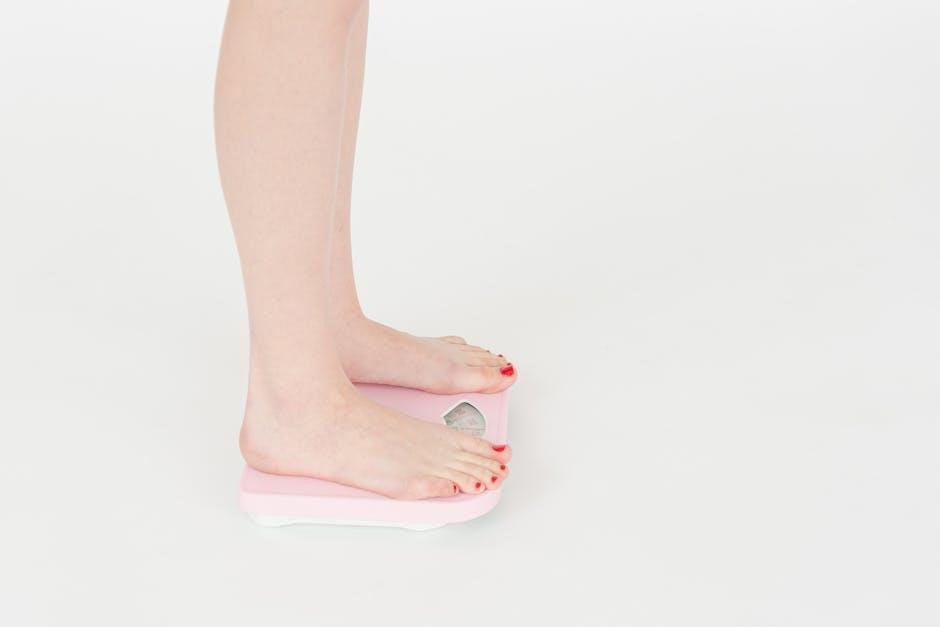
With the scale prepared – displaying “0.0” – you are ready to obtain your weight measurement. Gently step onto the scale platform, ensuring your weight is evenly distributed for an accurate reading. Avoid any sudden movements or shifting of your weight during the measurement process.
The scale will briefly display “000” before presenting your current weight. The unit of measurement (lbs or kg) will depend on the switch setting you previously selected. Allow a few seconds for the reading to stabilize before noting the result.
The scale is designed for immediate readings; however, consistent placement on the scale surface is recommended for optimal accuracy. Remember to remain still until the weight reading is locked and displayed.
Understanding Body Analysis Features
This WW scale offers advanced body analysis capabilities beyond simple weight measurement. After obtaining your weight, the scale automatically calculates and displays additional body composition metrics. These features provide a more comprehensive understanding of your overall health and progress.
The scale assesses key indicators such as Body Fat Percentage, Muscle Mass, Water Percentage, and Bone Mass. These values are derived from bioelectrical impedance analysis (BIA), a safe and non-invasive technology. The scale sends a small, harmless electrical signal through your body to measure resistance.
Remember that these measurements are estimates and can be influenced by factors like hydration levels and recent exercise. Consistent measurement conditions will improve accuracy. The scale will cycle through these body composition values after displaying your weight.
Interpreting the Results
Once the scale displays your body composition data – Body Fat Percentage, Muscle Mass, Water Percentage, and Bone Mass – understanding these values is crucial. Remember these are estimates, influenced by hydration and activity. Consistent measurement times are key for tracking trends.

Body Fat Percentage indicates the proportion of your weight that is fat. Muscle Mass reflects the weight of your muscles. Water Percentage shows the amount of water in your body, vital for health. Bone Mass estimates the weight of your skeletal structure.
Focus on observing changes over time rather than fixating on single readings. Use this data alongside your weight to monitor progress towards your wellness goals. Consult a healthcare professional for personalized interpretation and guidance regarding your results.
Troubleshooting Common Issues
Scale won’t turn on: Ensure fresh batteries are correctly installed. If the issue persists, try replacing the battery compartment cover, ensuring a secure connection. Inconsistent readings: Verify the scale is on a hard, level surface. Avoid carpets or uneven flooring. Ensure your feet are positioned correctly on the electrodes.
Error messages: Refer to the scale’s manual for specific error code definitions. Often, these indicate low battery or exceeding the weight capacity. Data not saving: Confirm you’ve completed the user profile setup correctly. Ensure the scale isn’t being moved during the setup process.
If problems continue, try resetting the scale by removing the batteries for several minutes. If none of these steps resolve the issue, contact Conair customer support for further assistance.
Battery Replacement
Low Battery Indicator: The scale will display an “Lo” indicator when the batteries need replacing. Do not mix old and new batteries. Always use appropriate battery types – typically AAA or AA, as specified on the battery compartment.
Accessing the Battery Compartment: Locate the battery compartment on the back or underside of the scale. Gently slide or lift the cover to open it. Remove the exhausted batteries, noting the correct polarity (+ and -) for installation of new ones.
Installing New Batteries: Insert the new batteries, ensuring the positive (+) and negative (-) ends align with the markings inside the compartment. Replace the battery cover securely. The scale should now power on and function correctly. Dispose of used batteries responsibly, following local regulations.
Cleaning and Maintenance
Regular Cleaning: To ensure accurate readings and prolong the life of your WW scale, regular cleaning is essential. Use a slightly damp cloth to wipe the surface of the scale. Avoid using harsh chemicals, abrasive cleaners, or excessive water, as these can damage the sensors.
Surface Protection: Always place the scale on a hard, level surface before use. Avoid carpets or uneven flooring, which can affect accuracy. Protect the scale from extreme temperatures, humidity, and direct sunlight.
Sensor Care: Be gentle when stepping onto the scale. Avoid dropping objects onto the surface, as this could damage the sensitive weight sensors. If the scale is not in use for an extended period, remove the batteries to prevent corrosion.
Safety Precautions
Important Considerations: This WW scale is designed for personal use only and should not be used for medical purposes. Consult with a healthcare professional for any health concerns or before making any decisions related to your health or treatment.
User Restrictions: Do not allow children to use the scale without adult supervision. Individuals with pacemakers or other implanted medical devices should consult their physician before using this scale, as it utilizes bioelectrical impedance analysis (BIA) technology.
Operational Safety: Avoid using the scale if it is damaged or malfunctioning. Do not attempt to disassemble or repair the scale yourself. If you experience any discomfort or unusual sensations during use, discontinue immediately. Ensure the scale is dry before each use to prevent slips and falls.
Scale Specifications
Model Number: WW714ZF. This Weight Watchers by Conair body analysis scale is engineered for accurate weight and body composition measurements. Capacity: The scale boasts a maximum weight capacity of 400 pounds (180 kilograms).
Display: Features a clear LCD display for easy readability of weight, body fat percentage, muscle mass, and water percentage. Units: Offers selectable units – pounds (lbs) or kilograms (kg) – to cater to user preference;
User Memory: Stores data for up to four individual users (P-01 to P-04), allowing personalized tracking. Power Source: Operates on two AAA batteries (included). Dimensions: Compact design for convenient storage. Technology: Utilizes Bioelectrical Impedance Analysis (BIA) for body composition assessment.