William Blake’s “London,” a powerful poem from Songs of Experience, vividly critiques the societal ills of 18th-century London,
exploring themes of oppression and suffering through potent symbolism. Analyzing this poem, often found in readily available “London” analysis PDF resources,
reveals Blake’s condemnation of industrialization and its impact on the human spirit, alongside critiques of institutional power structures.
Historical Context of the Poem
“London” was composed in 1794, amidst a period of significant social and political upheaval in England. The poem reflects the anxieties of the early Industrial Revolution, a time marked by rapid urbanization, widespread poverty, and harsh working conditions. Blake witnessed firsthand the grim realities of London life, including child labor, prostitution, and the oppressive weight of governmental control.
The French Revolution’s influence, and the subsequent British response, fueled anxieties about social order and rebellion. Blake, a radical thinker, critiqued the established institutions – the Church, the monarchy, and the military – that he believed perpetuated suffering. Examining a “London” analysis PDF reveals how these historical currents shaped Blake’s poetic vision, transforming the city into a symbol of societal decay and spiritual confinement. The poem serves as a potent indictment of a society prioritizing profit over human well-being.
Overview of Blake’s Poetic Style
William Blake possessed a uniquely visionary poetic style, characterized by symbolic imagery, lyrical intensity, and a rejection of conventional poetic forms. He frequently employed simple language to convey complex ideas, often utilizing repetition and rhetorical questions to emphasize his themes. A “London” analysis PDF highlights Blake’s use of contrasting imagery – innocence versus experience, light versus darkness – to explore the duality of human existence.
Blake’s poetry is deeply rooted in his mystical beliefs and his critique of rationalism. He favored a highly personal and imaginative approach, often creating his own mythology. His illuminated printing, combining poetry and visual art, further enhanced the symbolic power of his work. “London” exemplifies his style through its concise structure and emotionally charged language, delivering a powerful social commentary.
Detailed Analysis of Stanza 1
Stanza one establishes the poem’s oppressive atmosphere, detailing the “chartered streets” and the pervasive “marks of weakness” and “woe,” as explored in a “London” analysis PDF.
“I wander through each chartered street” ─ Exploration of Restriction
The opening line, “I wander through each chartered street,” immediately establishes a sense of confinement and control, a key theme readily discussed in a “London” analysis PDF. The word “chartered” implies that even the streets of London are owned and regulated, denying freedom and spontaneity. This isn’t a natural urban landscape, but one meticulously planned and governed, symbolizing the restrictions imposed upon individuals by societal forces.
Blake’s use of “wander” suggests a passive observation, a feeling of being lost within this controlled environment. The speaker isn’t actively participating in life, but rather drifting through a space that denies authentic experience. This initial image sets the stage for the subsequent exploration of suffering and oppression, highlighting how the very fabric of the city contributes to the citizens’ plight.
“Marks of weakness, marks of woe” ─ Symbolism of Suffering
The repetition of “marks” in “Marks of weakness, marks of woe” powerfully emphasizes the pervasive nature of suffering, a point frequently analyzed in a “London” analysis PDF. These aren’t isolated incidents, but visible signs etched onto the faces of Londoners, representing both physical and emotional distress. “Weakness” suggests vulnerability and powerlessness, while “woe” denotes deep sorrow and grief.
Blake employs these phrases to universalize the experience of pain, indicating that suffering isn’t confined to a specific social class or individual. It’s a collective burden borne by all inhabitants of the city. The stark simplicity of the language amplifies the emotional impact, creating a haunting image of a population burdened by hardship and despair, a central theme in Blake’s critique.
“In every face I meet” ‒ Universality of Pain
The line “In every face I meet” reinforces the poem’s central argument: suffering is not isolated, but a ubiquitous condition within London, a point often detailed in a “London” analysis PDF. Blake doesn’t encounter a single instance of distress; instead, it’s a constant, inescapable reality reflected in the visages of everyone he encounters.
This universality suggests a systemic problem, implying that the causes of suffering are deeply embedded within the social and political structures of the city. It’s not merely individual misfortune, but a collective experience imposed upon the population. The phrase emphasizes the speaker’s overwhelming sense of despair and the all-encompassing nature of London’s misery.
“The mind-forged manacles” ‒ Internalized Oppression
Perhaps the most striking image in the poem, “the mind-forged manacles” signifies a particularly insidious form of control, frequently explored within a “London” analysis PDF. These aren’t physical chains, but mental constraints – limitations imposed not by external forces alone, but internalized by the individuals themselves.
Blake suggests that the people of London are trapped by their own thought patterns and perceptions, shaped by the oppressive systems around them. This internalized oppression is arguably more powerful than physical bondage, as it restricts their ability to even conceive of freedom. The phrase highlights the devastating psychological impact of societal control, rendering individuals complicit in their own subjugation.

Detailed Analysis of Stanza 2
The second stanza intensifies the poem’s critique, detailing specific instances of suffering – child labor, religious hypocrisy, and the horrors of war – as detailed in many a “London” analysis PDF.
“The chimney-sweeper’s cry” ‒ Child Labor and Exploitation
Blake’s inclusion of “the chimney-sweeper’s cry” is a direct indictment of the widespread exploitation of children during the Industrial Revolution. These young boys were forced into dangerous and filthy work, often leading to illness and premature death. A thorough “London” analysis PDF will highlight how this image evokes profound sympathy and outrage.
The cry itself isn’t just a sound; it’s a symbol of lost innocence and the crushing weight of societal injustice. Blake doesn’t simply present the fact of child labor, but rather emphasizes the emotional toll it takes on these vulnerable individuals. The poem’s power lies in its ability to personalize this systemic problem, forcing readers to confront the human cost of progress. Examining critical resources, like a detailed “London” analysis PDF, reveals the poem’s lasting relevance.
“The blackening church” ‒ Critique of Institutional Religion
Blake’s depiction of “the blackening church” serves as a scathing critique of the established Church of England and its perceived hypocrisy. The darkening imagery suggests corruption and a moral decay within the institution, contrasting sharply with its supposed role as a beacon of spiritual guidance. A comprehensive “London” analysis PDF will explore this symbolic representation.
Blake wasn’t necessarily anti-religious, but rather opposed to organized religion that he believed stifled individual spirituality and perpetuated social control. The “blackening” implies a tarnishing of faith, suggesting the church actively participates in the oppression he details throughout the poem. Further study, utilizing a “London” analysis PDF, reveals Blake’s complex relationship with religious authority and his advocacy for a more personal, experiential faith.
“And the hapless soldier’s sigh” ─ The Cost of War
Blake’s inclusion of “the hapless soldier’s sigh” powerfully illustrates the human cost of war and imperial ambition, prevalent during the period. This line isn’t simply about battlefield casualties; it represents the broader suffering inflicted upon individuals caught within systems of power and conflict. A detailed “London” analysis PDF will unpack this layered meaning.
The “sigh” embodies quiet desperation and the loss of vitality, highlighting the emotional and psychological toll of military service. Blake critiques the glorification of war, exposing its devastating impact on ordinary people. Examining a “London” analysis PDF reveals how this image connects to the poem’s overarching theme of systemic oppression, where even those defending the nation are victims of its injustices.
“Runs in blood down palace walls” ─ Violence and Inequality
The shocking image of “blood down palace walls” is arguably the most visceral in “London,” representing the brutal consequences of social injustice and unchecked power. A comprehensive “London” analysis PDF will emphasize this line’s potent symbolism, linking it to the poem’s critique of societal structures. This isn’t literal bloodshed, but a metaphorical representation of suffering inflicted upon the populace by those in authority.
The juxtaposition of opulent “palaces” with flowing blood highlights the stark inequality at the heart of London society. Blake suggests that the wealth and privilege of the ruling class are built upon the pain and exploitation of the vulnerable. Further exploration within a “London” analysis PDF reveals how this image underscores the poem’s central argument: that power corrupts and perpetuates cycles of violence.
Themes in “London”
“London” explores social injustice, industrialization’s corruption, lost innocence, and critiques power. A “London” analysis PDF reveals these interwoven themes, showcasing Blake’s societal commentary.
Social Injustice and Inequality
Blake’s “London” relentlessly portrays the stark social injustices prevalent during the Industrial Revolution. A detailed “London” analysis PDF highlights the poem’s depiction of suffering etched “in every face,” signifying widespread woe. The jarring juxtaposition of “palaces of gold” with “men in chains,” as noted in critical appreciations, powerfully illustrates the extreme inequality.
This contrast isn’t merely economic; it represents a moral and spiritual bondage. The poem suggests that wealth is built upon the exploitation and oppression of the vulnerable. The “marks of weakness, marks of woe” aren’t isolated incidents but systemic consequences of a society prioritizing profit over people. Blake’s work, therefore, serves as a scathing indictment of a system that perpetuates suffering for the benefit of the few.
The Corrupting Influence of Industrialization
“London” powerfully critiques the detrimental effects of industrialization, a central theme explored in many a “London” analysis PDF. Blake doesn’t directly depict factories, but the poem’s atmosphere of confinement and despair implicitly indicts the burgeoning industrial landscape. The “chartered street” symbolizes a controlled, regulated existence, stifling natural human expression.
This imposed order, driven by industrial progress, is presented as inherently oppressive. The “mind-forged manacles” represent the psychological constraints imposed by a society focused on production and control. Industrialization, in Blake’s view, doesn’t liberate but enslaves, corrupting both the individual and the collective spirit, leaving lasting “marks of woe” upon the city and its inhabitants.
Loss of Innocence and Experience
Blake’s “London,” frequently dissected in “London” analysis PDF documents, starkly contrasts with the idyllic visions of his Songs of Innocence, highlighting a profound loss of innocence. The poem depicts a world where childhood is blighted by exploitation – the chimney-sweeper’s cry – and where even the church, a symbol of spiritual solace, is “blackening,” corrupted by societal ills.
This loss isn’t merely a personal tragedy but a systemic one, affecting all levels of society. The poem suggests that experience, in the context of industrial London, inevitably leads to suffering and disillusionment. The pervasive “marks of weakness, marks of woe” demonstrate a collective trauma, a shared loss of hope and purity, forever etched upon the faces of its citizens.
Critique of Power Structures
“London,” as explored in detailed “London” analysis PDF studies, presents a scathing critique of the established power structures of Blake’s time. The poem doesn’t directly name oppressors, but implies systemic control through imagery of “chartered streets” and “manacles.” These aren’t merely physical restraints, but “mind-forged manacles,” suggesting internalized oppression and the insidious control of thought.
The juxtaposition of “palaces” and the suffering of the populace – the soldier, the chimney-sweeper – exposes vast social inequalities. The “blood” running down palace walls symbolizes the violence and exploitation underpinning the wealth and authority of the ruling class. Blake challenges the legitimacy of these structures, questioning their moral foundations and their impact on the lives of ordinary people.
Symbolism in “London”
Blake’s “London,” detailed in many a “London” analysis PDF, employs potent symbolism; the Thames represents both life and decay, while “manacles” embody constraints.
The River Thames as a Symbol of Life and Decay
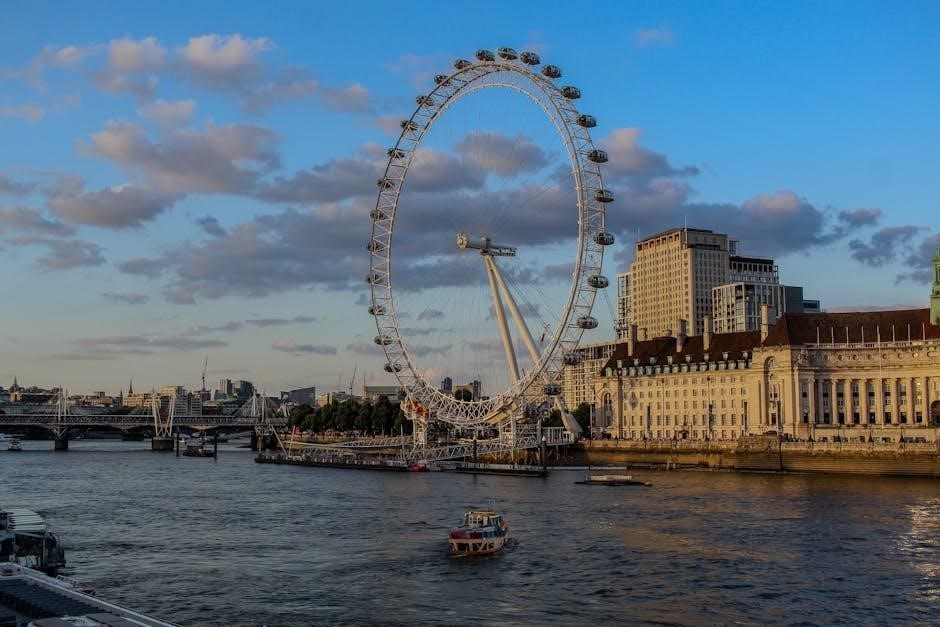
The River Thames, central to London’s geography and history, functions as a complex symbol within Blake’s poem, frequently explored in “London” analysis PDF documents. Traditionally representing life-giving sustenance and commerce, the Thames in “London” is subtly tainted, reflecting the city’s moral and spiritual corruption.
While the river sustains the city, it also carries the “blood” of suffering – a metaphorical representation of the exploitation and oppression prevalent during the Industrial Revolution. This duality highlights Blake’s vision of London as a place where vitality is simultaneously nurtured and destroyed. The river’s flow, therefore, isn’t purely life-affirming; it’s a conduit for both creation and decay, mirroring the poem’s overall pessimistic tone. Examining scholarly analyses reveals this nuanced interpretation.
“Palaces” and “Walls” ‒ Representations of Authority
“Palaces” and “walls” within Blake’s “London,” as detailed in numerous “London” analysis PDF resources, powerfully symbolize the oppressive structures of authority. The “palaces of gold” represent the wealth and power concentrated in the hands of the ruling class, sharply contrasted with the “manacles” that bind the people.
These opulent structures aren’t presented as symbols of benevolent leadership, but rather as fortresses built upon exploitation and suffering. The “walls” physically and metaphorically enclose and restrict the citizens, embodying the limitations imposed by societal norms and political control. Blake critiques how authority, instead of protecting, actively contributes to the city’s pervasive misery, a key theme in critical interpretations.
“Manacles” ─ Physical and Mental Constraints
“The mind-forged manacles” are central to understanding Blake’s “London,” frequently analyzed in “London” analysis PDF guides. These aren’t literal chains, but represent the internalized oppression and psychological constraints imposed by societal forces. They symbolize how individuals willingly accept and perpetuate their own subjugation, limiting their freedom and critical thought.
Blake suggests that these mental shackles are more potent than physical ones, hindering rebellion and reinforcing the status quo. The image, coupled with the “palaces” and suffering, highlights a system where power controls not just bodies, but also minds. This concept underscores Blake’s critique of institutions and their ability to shape perception, a recurring theme in his work.
“London” in Relation to Blake’s Other Works
“London” deeply connects to Blake’s Songs of Innocence and of Experience, serving as a stark counterpoint, showcasing his prophetic vision, as detailed in many a “London” analysis PDF.
Connections to Songs of Innocence and of Experience
Blake’s “London” exists as a crucial component within the contrasting collection of Songs of Innocence and of Experience, representing a descent into the darker realities of urban life. Many “London” analysis PDF documents highlight this duality. While Innocence portrays a pastoral, idealized world, Experience—where “London” resides—reveals a corrupted and oppressive society.
The poem directly responds to themes explored in Innocence, offering a cynical perspective on the institutions and societal structures previously presented with a degree of hopeful ambiguity. For example, the innocence of childhood, celebrated in poems like “The Lamb,” is shattered by the grim depiction of child labor in “London.” This deliberate juxtaposition underscores Blake’s belief that societal forces actively destroy inherent goodness. Examining a “London” analysis PDF will reveal how the poem functions as a critical commentary on the loss of innocence and the pervasive influence of experience.
Blake’s Prophetic Vision and “London”
Blake was not merely a poet, but a visionary who believed in a spiritual awakening and actively critiqued the constraints imposed by reason and societal norms. A thorough “London” analysis PDF will demonstrate how the poem embodies this prophetic element. “London” isn’t simply a description of a city; it’s a condemnation of the forces—political, economic, and religious—that stifle the human spirit.
His prophetic works often feature symbolic representations of good and evil, and “London” reflects this through its imagery of confinement and suffering. The “mind-forged manacles” represent the internalized oppression that prevents individuals from realizing their full potential. Studying a “London” analysis PDF reveals how Blake’s vision extends beyond the immediate context of 18th-century London, offering a timeless warning against all forms of control and a call for spiritual liberation.
Critical Reception and Interpretations of “London”
“London” has consistently sparked debate, with interpretations ranging from socio-political critiques to psychological explorations, as detailed in many a “London” analysis PDF.
Early Responses to the Poem
Initial reception of “London” was largely muted, as Blake’s work didn’t achieve widespread recognition during his lifetime. Contemporary critics, accustomed to more conventional poetic forms, often found Blake’s style and subject matter challenging and unconventional. Many “London” analysis PDF documents highlight that the poem’s radical critique of societal structures – the Church, the monarchy, and industrialization – likely contributed to its initial lack of acclaim.
Furthermore, the poem’s publication within Songs of Experience, alongside its companion volume Songs of Innocence, presented a complex and often unsettling vision of humanity. Readers expecting straightforward moral lessons were confronted with a darker, more ambiguous perspective. Early commentary, often found in biographical and critical studies accessible as a “London” analysis PDF, suggests a general sense of bewilderment and discomfort with Blake’s prophetic voice.
Modern Critical Perspectives
Contemporary scholarship, readily available through “London” analysis PDF resources, views Blake’s “London” as a seminal work of Romantic poetry and social critique. Modern critics emphasize the poem’s prescient understanding of the dehumanizing effects of industrialization and the oppressive nature of power structures. Marxist interpretations highlight the poem’s depiction of class struggle and economic exploitation, while feminist readings explore the subjugation of individuals within a patriarchal society.
Poststructuralist analyses, often detailed in comprehensive “London” analysis PDF guides, focus on the poem’s ambiguous language and its challenge to fixed meanings. Critics now recognize Blake’s innovative use of symbolism and his rejection of traditional poetic conventions. The poem’s enduring relevance lies in its ability to resonate with contemporary concerns about social justice, political oppression, and the loss of individual freedom.
Resources for Further Study: “London” Analysis PDF
Numerous online databases and scholarly articles offer in-depth “London” analysis PDF materials. Annotated editions provide valuable context, enhancing understanding of Blake’s complex poem.
Online Databases and Scholarly Articles
Accessing scholarly resources is crucial for a comprehensive “London” analysis PDF study. JSTOR and Project MUSE offer peer-reviewed articles dissecting Blake’s poem, exploring its historical context and symbolic layers. The Blake Archive, a digital resource, provides high-resolution images of Blake’s illuminated manuscripts, offering insights into his artistic process.
Google Scholar is also invaluable, yielding a wealth of academic papers. Searching for keywords like “Blake London analysis,” “Songs of Experience criticism,” or “industrial revolution poetry” will uncover relevant research. Many university libraries provide online access to these databases for registered students and faculty. Remember to critically evaluate sources, considering the author’s perspective and publication date for a well-rounded understanding.
Availability of Annotated Editions
Several annotated editions of William Blake’s poems, including “London,” are readily available, enhancing a “London” analysis PDF study. Oxford World’s Classics and Norton Critical Editions offer comprehensive introductions, textual notes, and critical essays. These editions provide valuable context regarding Blake’s life, the historical period, and interpretive challenges.
Penguin Books also publishes accessible and well-annotated collections of Blake’s work. Online booksellers like Amazon and Barnes & Noble stock these editions, often with preview options. Utilizing annotated editions alongside digital resources ensures a thorough understanding of the poem’s complexities, aiding in a nuanced and informed analysis.